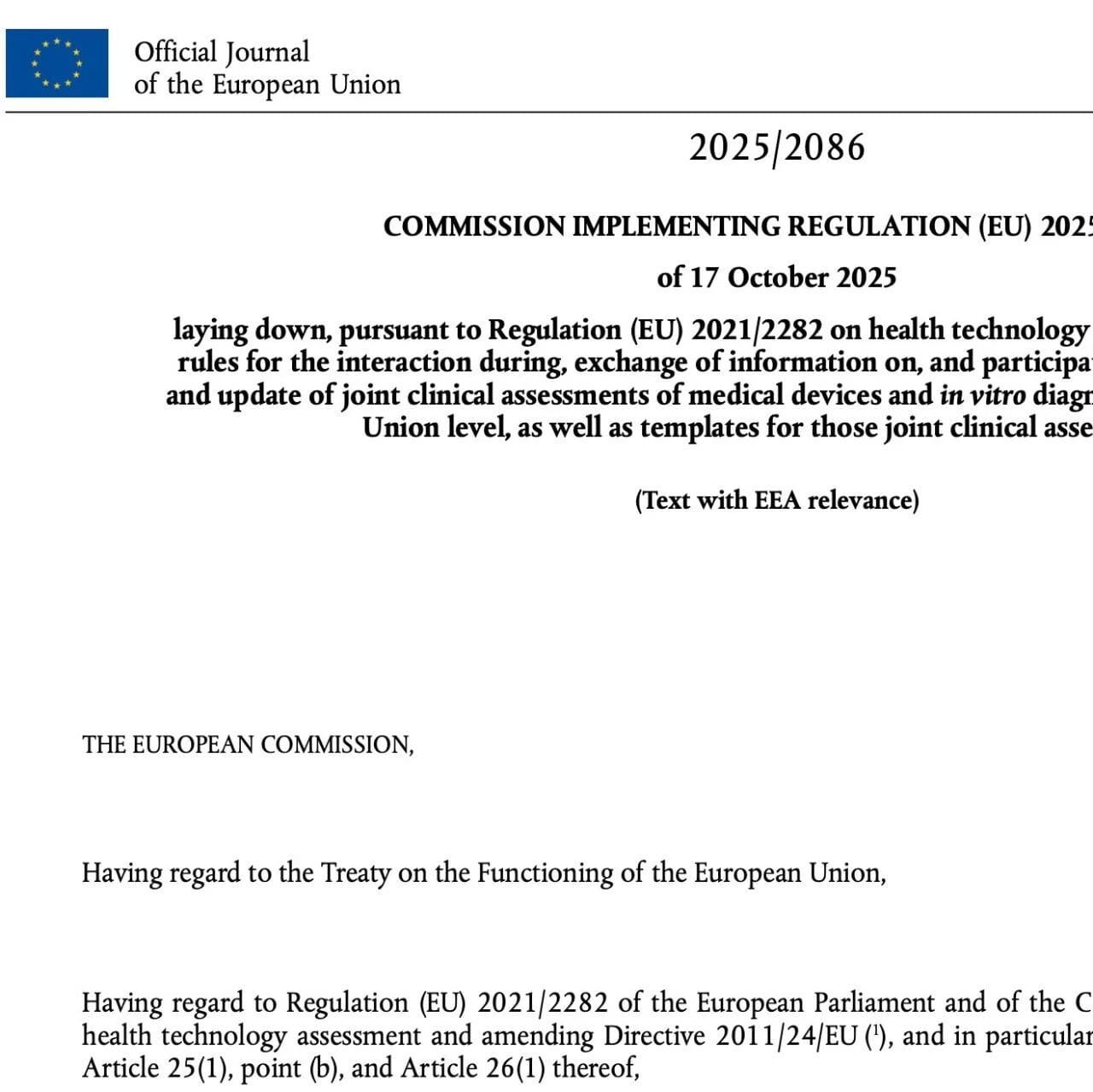
From the perspective of corporate compliance and strategic response, this article provides a systematic interpretation of Commission Implementing Regulation (EU) 2025/2086 to help medical device and in vitro diagnostic (IVD) companies understand the regulatory requirements in advance, identify key changes, and develop compliance and clinical management response strategies.
I. Regulatory Objective: Establish a unified, transparent, and efficient EU Joint Clinical Assessment system
This Regulation was issued to implement the EU Health Technology Assessment (HTA) Framework Regulation (EU) 2021/2282,by establishing the Joint Clinical Assessment (JCA)JSC(Joint Scientific Consultation)system,to address issues such as duplicate assessments, inconsistent standards, and information barriers among Member States.
Its core objectives include:
1. Establish a unified assessment process and standardized templates;
2. Improve the transparency and consistency of assessments of medical devices andIVDclinical evidence;
3. Coordinate with theMDR/IVDRregulatory submission system to shorten the timeline from market launch to market access;
4. Reduce the administrative and compliance burden on companies caused by duplicate multi-countryHTAassessments.
II. Document Templates and Requirements
Main text+Five annex templates:Annex I(deviceDossier)、Annex II(IVD Dossier)、Annex III(deviceJCAreport),Annex IV(IVD JCAreport),Annex V(summary report).Clear requirements andCER/PER、CEAR、CEP、PMCF, registration/clinical/real-world evidence and statistical analysis plans, andinPICOpresentevidence on relative effectiveness and safety; note(EU) 2025/2086 repeatedly emphasizes the importance of PICO and its requirements。
III. Core Content and Key Points of Focus for Companies
1. Assessment initiation: once the device/IVDobtainsMDR/IVDR certification, the Committee may initiate a Joint Clinical Assessment. The company must, within7 days, submit the required materials or provideEUDAMEDreferences.
2. Scoping (PICOframework): the assessment subgroup will define the scope within60 days, and the company may request one scope clarification meeting.
3. Report submission process: the initial dossier submission is completed within100 days; supplementary submissions7–30 days; the total assessment cycle is approximately165 days.
4. Standardized dossier structure: the regulatory annexesI–Vspecify the device/IVDdossier template, report template, and summary content.
5. Balancing data transparency and confidentiality: the assessment report will be made public, and the company must proactively identify and justify confidential information.
IV. Impacts and Changes for Companies
1. Deep integration of registration and market access pathways:JCAmay be initiatedCEimmediately after certification, requiring companies to align their regulatory submission and market access evidence strategies from the outset.
2. Earlier integration of methodological and evidence standards:Companies must considerPICO, comparator selection, and key endpoint design during the clinical study stage.
3. Compliance and project management challenges: multiple deadlines (7/20/60/100/165days) require companies to respond rapidly.
4. Transparency risks and data management: with greater public disclosure, protection of commercial confidential information must be planned in advance and supported by traceable justification.
V. Corporate response strategies and compliance recommendations
1. EstablishJCAresponse team: form a cross-functional team (regulatory, clinical,HTA, regulatory affairs, data, and market access), and develop internal process maps, task lists, and responsibility allocation mechanisms.
2. Strengthen the evidence management system: in accordance withAnnextemplates to organizeCER/PER/PMCF/statistical and related documentation, ensuring consistency and traceability.
3. Methodological planning: incorporateHTA/PICOdesign requirements at the clinical protocol stage to reduce insufficient data during the assessment phase.
4. Strengthen data security and confidentiality strategies: establish templates for commercial confidential information labeling and justification, supported by legal review mechanisms.
5. Build internalHTAcapabilities: improve the team's understanding ofHTAmethodologies (indirect comparison, networkMetameta-analysis,RWE) and their practical application.
VI. Key milestones and action plan
Certificate/IFU/Other necessary information:7dayssubmit within (or citeEUDAMED, if applicable)。
Final scope of assessment:60days(or after selection10days, whichever is later).
“Scope briefing meeting”: within days after the scope is finalized20days。
DossierInitial draft:100days(can be extended by≤30days)。
Second supplementary submission:15days(for minor gaps7days)。
New clinical datato be included as a safeguard item:after compliance is confirmed60daysThe submitted data must be taken into consideration.
JCAThe subgroup forms the final revised draft:165days。
The coordination group shall approve it within 30 days of receiving the revised Joint Clinical Assessment and summary report, in accordance with Article 12(2) of Regulation (EU) No 2021/2282.
Update (noPICO/changePICO):165days / 345days。
Restart: after Member States share data10working daysto complete the feasibility check.
VII. Potential Risks and Recommendations
1. PICORisk of definition misalignment: use Joint Scientific Consultation (JSC) to align clinical comparators and endpoint selection in advance.
2. Timeline management risk: establish an internal early-warning system and backup accountable-owner mechanism.
3. Risk of disclosure of commercially confidential information: adopt an item-by-item confidentiality designation and substitute-disclosure strategy.
4. Data consistency risk: ensure that different versions of documentation (regulatory submission, HTA, market access) remain synchronized.
VIII. Conclusion: From Passive Compliance to Proactive Evidence Management
EU 2025/2086 marks a systemic shift in the EU medical device sector from regulatory compliance toward“regulatory submission–+market access” integration as a systemic transformation. If companies can proactively embedHTAthis mindset into R&D, regulatory submission, and market access strategy, and build a rapid cross-functional response system, they will shift from passive response to proactive competition under the new regulatory framework.