
Regulatory background
Info.
An effective Clinical Evaluation Plan acts like a guideline, guiding and harmonising the clinical evaluation process and ensuring sufficient rigor and objectivity from start to finish.
A high-quality Clinical Evaluation Plan serves like a roadmap, guiding and coordinating the clinical evaluation process,ensuring sufficient rigor and objectivity from start to finish。
Article 61(3) of the MDR states that a clinical evaluation must “follow a defined and methodologically sound procedure”, meaning that a Clinical Evaluation Plan needs to be established in advance and should define how the evaluation shall be conducted.
Article 61(3) of the Medical Device Regulation states that the clinical evaluation must “follow a defined and methodologically sound procedure,” which means that a Clinical Evaluation Plan must be established in advance and the implementation approach must be clearly defined.
MDR Annex XIV Part A provides further details on requirements for CEPs, stating that it should include at least the following:
Annex XIV Part A of the Medical Device Regulation (MDR) provides further detail on the requirements for the Clinical Evaluation Plan (CEP), stating that it should include at least the following:
・An identification of the GSPRs that require support from relevant clinical data;
・A specification of the intended purpose of the device;
・A clear specification of intended target groups with clear indications and contra-indications;
・A detailed description of intended clinical benefits with relevant and specified clinical outcome parameters;
・A specification of methods to be used for examination of qualitative and quantitative aspects of clinical safety with clear reference to the determination of residual risks and side-effects;
・An indicative list and specification of parameters to be used to determine, based on the state of the art in medicine, the acceptability of the benefit-risk ratio for the various indications and for the intended purpose or purposes of the device;
・An indication how benefit-risk issues… are to be addressed; and
・A clinical development plan
・identification of the General Safety and Performance Requirements (GSPRs) that require support from relevant clinical data;
・a description of the intended purpose of the device;
・a clear definition of the target population, including clearly defined indications and contraindications;
・a detailed description of the expected clinical benefits, together with the relevant and specified clinical outcome parameters;
・a description of the methods used to examine the qualitative and quantitative aspects of clinical safety, with explicit reference to the determination of residual risks and side effects;
・an indicative list and specification of the parameters to be used to determine, based on the State of the Art and best medical practice, the acceptability of the benefit-risk ratio for the various indications and for one or more intended purposes of the device;
・an explanation of how benefit-risk issues will be addressed; and
・the clinical development plan
Practical experience
Prac.
However, this list constitutes the bare minimum of what should be included in a CEP and, as written in the MDR, isn’t easy to follow. Let’s look in more detail at how to structure a Clinical Evaluation Plan.
However, this list contains only the most basic content that a Clinical Evaluation Plan (CEP) should cover, and as written in the Medical Device Regulation (MDR), it is not easy to interpret or implement in practice. Below, we look in more detail at how to build a high-quality Clinical Evaluation Plan that meets reviewer expectations.
How should a Clinical Evaluation Plan be structured?
How should a Clinical Evaluation Plan be structured?
When planning the structure of a CEP, it’s worth having a simple framework in mind that can be used as a reference point. One such framework of key requirements is as follows:
When planning the structure of a CEP, it is valuable to keep in mind a simple framework that can serve as a reference point. One key requirements framework is as follows:
・Identification, classification and general description of the device
・Background and purpose of the CEP
・Summary of CEP methodology (e.g. use of literature / equivalence route, etc)
・A hypothesis to be tested during the evaluation
・Intended purpose, clinical benefits, indications and contraindications
・Identification of similar devices
・Analysis of relevant and non-relevant GSPRs with justification for any non-relevant
・A detailed search protocol for identifying, appraising and analysing clinical evidence.
Each section should be clearly written in sufficient detail to enable people other than the author to precisely follow the ‘recipe’.
Two aspects of a Clinical Evaluation Plan that commonly cause confusion are the need to construct a hypothesis and the requirement to set out a Search Protocol. For this reason, each of these deserves specific consideration.
Each section should be writtenclearly and in sufficient detail so that someone other than the author can accurately follow this “plan”. Two aspects of a Clinical Evaluation Plan that commonly cause confusion are the need to formulate hypotheses and the requirement to develop a literature search strategy. Both therefore merit dedicated consideration.
CEP Template
Template.
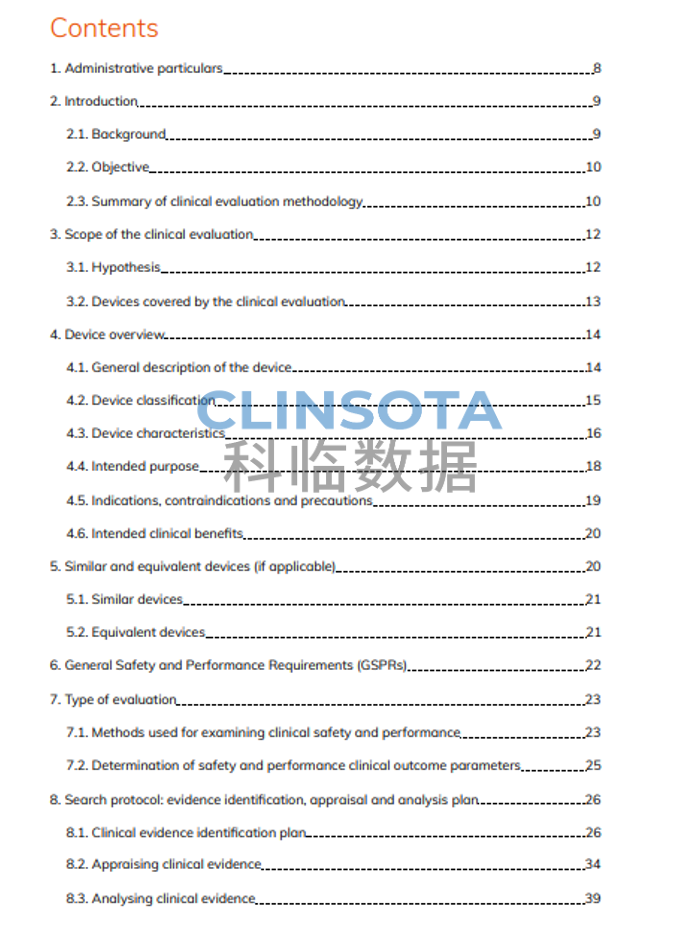
The following is a partial Clinical Evaluation Plan template outline prepared in accordance with MDR and MDCG requirements, for reference only:
Key Considerations
Propose.
1. At the CEP stage, plan the clinical data needed to support the claimed safety and effectiveness (including but not limited to clinical trial data);
2. At the CEP stage, identify the equivalent and similar devices if an equivalence route is to be pursued;
3. Define the Clinical Benefits you intend to claim and plan the scope of evidence needed to demonstrate them;
4. Define the SOTA, Safety&Performance, and AC;
5. Develop a literature search scope and strategy that are "efficient, scientific, logical, and traceable"
6. Collect clinical evidence in line with the planned clinical evaluation framework.