← Back to English Insights
Medical device regulatory insight · 2026-01-11
FDA Releases a Summary of the 2026 Medical Device Guidance Agenda
A-List Highlight: Final RWE Guidance + Final AI/ML PCCP Guidance Are About to Land, and the window for specialist CROs to position early is now open

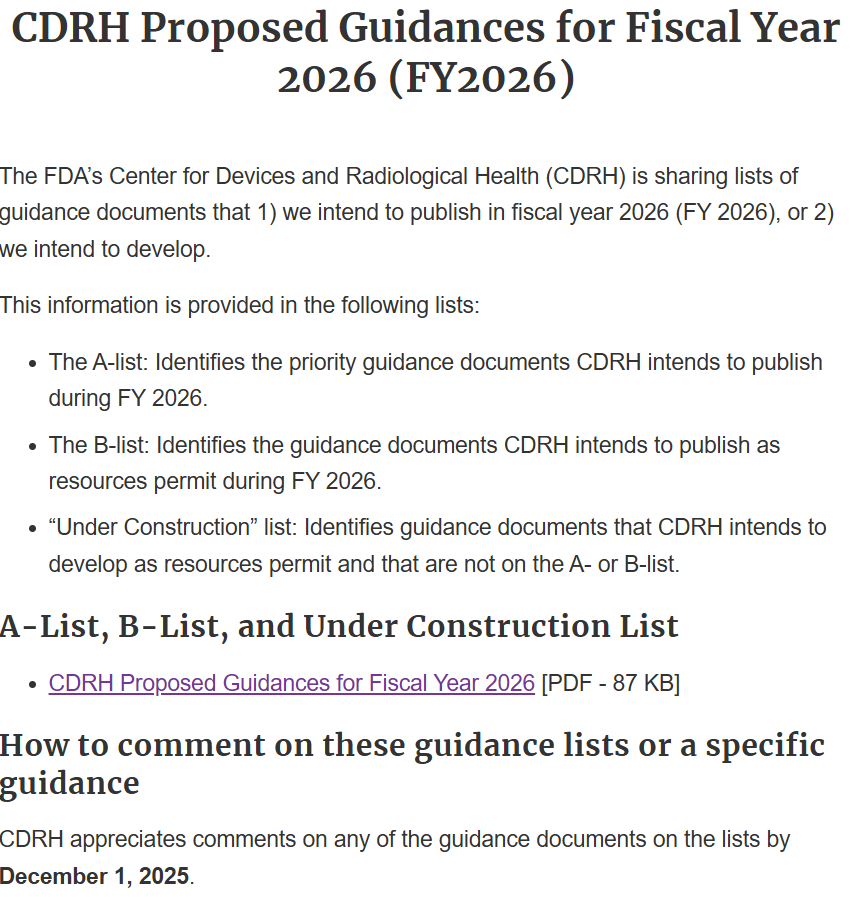
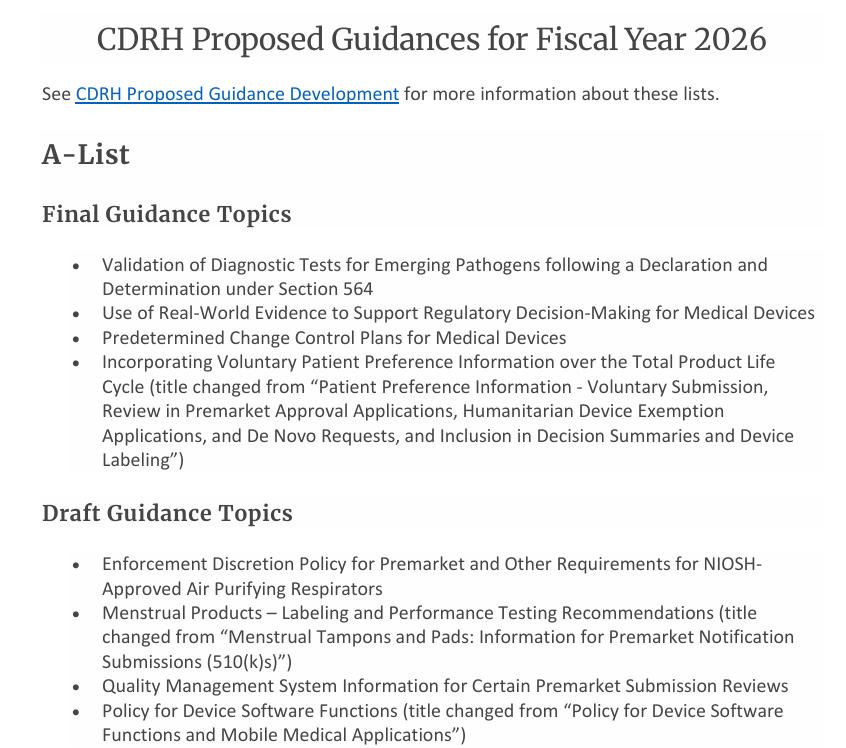
In autumn 2025, FDA CDRH released theFiscal Year 2026(2025.10.1–2026.9.30) list of guidance documents planned for issuance.Although this list contains fewer items, theA-Listhas reached a recent high in both substance and focus, with the most direct impact on AI/ML, SaMD, digital therapeutics, and high-risk diagnostic products.Core A-List priorities (final guidance expected within the year)
Use of Real-World Evidence to Support Regulatory Decision-Making for Medical Devices (final) → Clarifies quality grading for RWD sources, fit-for-purpose principles, methods for controlling bias/confounding, statistical analysis plan requirements, and standards for determining the strength of bridging evidence relative to traditional clinical trialsMarketing Submission Recommendations for a Predetermined Change Control Plan for Artificial Intelligence/Machine Learning (AI/ML)-Enabled Device Software Functions (final) → Further operationalizes the three core PCCP modules: • Description of Intended Modifications • Modification Protocol (triggering conditions, re-training datasets, performance thresholds, acceptance criteria) • Impact Assessment (risk reclassification, validation strategy, TPLC monitoring plan)Validation of In Vitro Diagnostic Tests for Emerging Pathogens (final)Incorporation of Patient Preference Information throughout the Total Product Life Cycle (final)In addition, updates to the Device Software Functions regulatory framework, as well as weight-loss devices, mental health/behavioral intervention devices, and robotically assisted surgical systems, have also entered the priority list.The most immediate challenges for sponsors
If the PCCP is poorly drafted → nearly all significant algorithm updates (including re-training, domain adaptation, and bias mitigation) will require resubmission under 510(k)/De Novo/PMA, driving time and cost up exponentiallyThe RWE pathway is opening, but the bar is higher → FDA's expectations for RWDdata integrity, representativeness, traceability, and consistency of endpoint definitionsare extremely stringent; 'hospital real-world data' alone can rarely directly support high-risk indication expansion or replace controlled comparative studiesPatient Preference Information (PPI) has formally entered the TPLC → late-stage clinical evaluation, label claims, and post-market surveillance will all require systematic evidence of the patient voiceThe core value of a specialized CRO is shifting from 'helping write the dossier' to 'designing the optimal evidence strategy for you'Over the past three years, we have supported more than 15 AI/ML + SaMD projects through the FDA pathway, including:For three AI imaging diagnostic software products,successful PCCP Q-Sub interactions(the modification protocol clearly defined trigger thresholds, validation set construction, and a performance drift monitoring plan, and FDA agreed that resubmission would not be required for every major version update)Multiple high-risk AI predictive models usedRWE supplementary evidenceto support De Novo/PMA deficiency responses (real-world multicenter data + target trial emulation framework + PSM/IPTW + multiple sensitivity analyses)For digital therapeutics (DTx) / mental health software, anintegrated evidence plan(RCT core data + RWD long-term benefit evidence + structured PPI collection), significantly shortening the overall review timelineThis is currently the most cost-effective window for engagementFY2026 has officially begun, and final A-List guidance is expected to be issued progressively in the first half of 2026.3-9 months in advanceto complete PCCP design, RWE data source planning, and Pre-Submission interactions can help companies avoid at least six months of detours after the new guidance takes effect, while also avoiding resource bottlenecks and price pressure caused by industry-wide clustering.