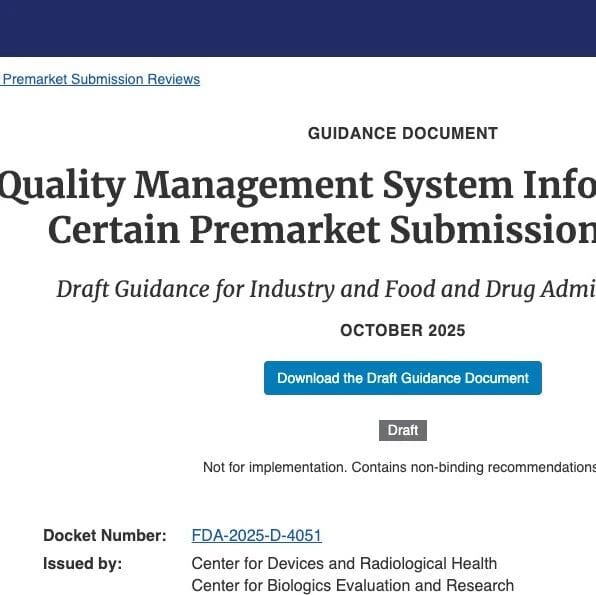
FDA draft issuedQuality Management System Information for Certain Premarket Submission Reviews, the opening and background section of the draft clearly states that QMSR through incorporation by reference ISO 13485:2016 and ISO 9000:2015 Chapter 3 references, and will 2026-02-02 take effect officially; once the draft is finally issued, it will replace the 2003 editionguidance. Companiesneed to conduct a gap analysis from the previous QS requirements to QMSR the new requirements(gap analysis), and use it as supporting documentation for submission or inspection readiness purposes
Applicable clause/section | Added/Key changes (compared with 2003new content compared with the previous version) | Suggested company response strategies |
Overall framework and effective date milestones (Introduction,II–III;P4–6) | QMSR will take effect on 2026-02-02 become effective as of that date,21 CFR Part 820 Structural reorganization:§820.1, 820.3, 820.7, 820.10 and supplementary §820.35、§820.45(most of the remainder is retained) The draft clarifies that, in marketing submissions, QMS information is used to demonstrate conformity with QMSR ; FDA may, based on the submitted/or refuse approval where other information indicates noncompliance (see VI the opening section). | · Use 2026-02-02 as a hard deadline to develop a transition plan: complete“QS→QMSR”a gap assessment; ·align ISO 13485:2016/ISO 9000:2015 terminology with processes; · in each PMA/HDE , provide a transitional/compliance plan and evidence index. |
V.A.(1) Format(P5) | Where a one-time submission of all QMSR information is permitted, submit only once“Cover Letter+General Information”; If modular PMA/batch submission is used, each submission must include General Information; It is recommended to make the QMSR information a standalone module; use eSTAR templates; for multi-site manufacturing, prepare a separate volume for each site and identify activities and responsibilities. | · Establish eSTAR apreparationmappingchecklist; for modular submissions, define document reuse and version control; · siteresponsibilitiesand scope statements should be standardized. |
V.A.(2) Cover Letter(P5–6) | Add and/strengthen cover letter fields: legal name and address, telephone,FEI/registration number, and relationship to the applicant,DUNS, contact person and backup telephone/email, and the date the site will be ready for inspection. | · Createastandard cover letter master template andincorporateinto master data governance; · At theprojectIn the plan, establish “inspection readiness” milestones; · Treat information changes as change-management triggers and synchronize cover information updates. |
V.A.(3) Content(P6) | Each site“ initiation form” should include at minimum: a copy of the cover letter; device description (including images, brand/ generic name, model,/ product code, existing identifiers UDI (if applicable),UDI assignment and maintenance plan, and intended use); principle of operation; and VI–IX all QMS referenced documents. | ·Improve device master data and UDI governance; establish a“ submission document index—VI andIX mapping” checklist; · legacyDocument review and perform necessary versioning and consistency checks。 |
VI.A(1) Basic expectations for establishing a QMS (P7) | Requires a risk-based approach to establish/ and maintain QMS; controls for outsourced processes and proportionality; QMS Software (electronic quality system/IT) validation and revalidation must be included. | · Establish“QMS a process risk register”, outsourcing categorization and control plans; · For eQMS/CSV software, define validation strategies and revalidation triggers; |
VI.A(2) General QMS documentation (P7) | Quality policy and objectives, quality manual (scope/ and process interactions), medical device file, and procedures and evidence for document and record control. | · Review the quality manual and terminology for alignment; QMSR; · establish“ document— records”list (including retention period and retrieval path); · management responsibilities for training-related positions |
VI.B (P8) | clarify the responsibilities of top management and the management representative; submit the management review input related to the device/output summary to demonstrate closed-loop accountability. | · standardize the management review cadence and templates; · output“ for FDA management review summary”(highlighting regulatory compliance, resources, risks, and the improvement system). |
VI.C(1) infrastructure (P8) | Describe the facility requirements/the suitability of the infrastructure for manufacturing, mix-up prevention, environmental control, logistics, and related operations. | · Submitproduction line/warehouse flow diagram, environmental monitoring and cross-contamination control plan, with photographs/schematic diagram. |
VI.C(2) Work Environment and Contamination Control (P9) | Provide a clear presentation of the work environment and contamination control requirements (including, where applicable, cleanliness/sterility/cross-contamination control logic). | · on arisk-basedbasis to set environmental condition limitsvaluesandmonitoringfrequency; · within the process/FMEA reflect contamination pathways, controls, and their 7.5.1/7.5.6/7.5.7 linkages. |
VI.D(1) Product realization and development process (P10) | emphasize that risk management runs throughout development planning and effectiveness verification, and is aligned with ISO 14971 . | · Establish“requirements—risk—verification/validation”three-way traceability; · make the effectiveness verificationevidence for verificationretrievable. |
VI.D(2) Design and Development(P10–14) | Demonstrate a complete set of design control elements: design planning; inputs (including emerging risk management); outputs (including procurement/production/service information and acceptance criteria/key characteristics); design review; design verification (including statistical methods); design validation (including explanation of differences from equivalent prototypes); transfer to production; design changes (grouped by impact and explain effects on existing V&V/clinical evidence); design document compilation. | · Establish“DHF submission-ready”table of contents structure and a unified traceability template; · For software/systems, add a system-level V&V; · design change classificationand rationalesubstantiationtemplates to standardize |
VI.D(3) procurement and suppliers(P14) | purchasing/and outsourcing processes must form a closed loop with design outputs and production controls and be commensurate with the risk class. | · CriticalSupplierTieringandPerformanceMetrics、QualityAgreement; · CriticalComponentsEarly-stageIntroductionQuality planning and incoming material verification plan. |
VI.D(4) Production and service provision (P15) | production controls, process validation, identification and traceability, visibility of distribution information, and ensure alignment with §820.45 labeling and packaging controls. | · Improve process validation (including software/ automation), in-process /and finished product release criteria and records; · bring labeling/Integrate packaging control procedures into production planning. |
VI.D(5) Monitoring and measuring equipment (P16) | Procedures and evidence for the control and calibration of measuring equipment/maintenance, and assurance of suitability must be submitted. | · Establish a master metrology data register, traceability, and nonconformitydisposition procedures; · risk classification of critical measuring equipment and redundancy. |
VI.E(1) Monitoring and measurement (P17) | Requirements are specified for presenting the procedures, metrics, and thresholds for monitoring and measurement activities related to complaints, production /processes, suppliers, and other areas. | · Build “complaint, —nonconformity, —CAPA—and change process-based management; · with a risk-driven approachofmonitoring thresholds。 |
VI.E(2) Nonconforming Product Control (P18) | Provide procedures for identification, segregation, review, and disposition of nonconforming product, and their interfaces with subsequent CAPA/changes. | · Improve MRB the mechanism and recurrence prevention; · Linkdisposition decisions withrisk assessment, customercomplaint/and return data. |
VI.E(3) Data Analysis (P19) | Provide a clear presentation of analyses and trends for data from production, rework/repair, complaints, and internal/external audits. | · Establish a data lake/metrics system and trend alerts; · reviewProvide keychartstables and root-cause/action summaries |
VI.E(4) Identification and implementation of necessary changes (P19) | Emphasize data-driven/risk-based change triggering and implementation, with a closed loop for effectiveness verification. | · Develop enterprise-levelchangechange governance (includingdesign/process/supply chain/software) and effectiveness verification SOP, and provide concrete evidence in the submission. |
VII §820.10(b) Applicable regulatory requirements(P20) | In addition to ISO 13485: UDI (Part 830; 7.5.8); traceability/device tracking (Part 821; 7.5.9.1); MDR(Part 803;8.2.3); corrections and/removals (Part 806;7.2.3/8.2.3/8.3.3)。 require that the submission include a summary of procedures and an explanation of their source. | · Establish“ISO 13485 subclause-to-—U.S. regulation”mapping; · Incorporate UDI/GUDID, tracking, and includingMDRmatters related to corrections and removals into the quality event governance manual and training; |
VIII §820.35 record control (P20–21) | In ISO 4.2.5 addition to , the submission must demonstrate: complaint records (8.2.2) , service activity records (7.5.4)、UDI/GUDID Record sampling (7.5.1/7.5.8/7.5.9)。 | · compile the record retention list and retention periods; · provide audit sampling package (including GUDID reconciliation and UDI use cases); · ensure complaint →exclusion and MDR decision logic are traceable. |
IX §820.45 Labeling and packaging controls (P21–22) | require submission of procedures that meet §820.45(a)–(c) requirements, covering package integrity under storage, transportation, and use conditions, operational/ inspection controls and records, etc. | · Establish label —and packaging end-to-end control maps; · version-control label artwork and implement dual review; · Packaging validation, including transportation/accelerated aging/seal integrity, etc. |
Regulatory interactions and the least burdensome principle (throughout the guidance) | Encourages Q-Submission pre-submission communication on high-risk concerns; organize materials in accordance with the least burdensome principle to facilitate review. | · At project initiation, plan Q-Sub milestone; · prepare a question list and gap summary, and pursue a modular/phased compliance plan to reduce review risk. |
The new version QMS ’s core substance and regulatory purpose
The new version QMSR(21 CFR Part 820, (revised edition)taking ISO 13485:2016 and ISO 9000:2015as international benchmarks, aiming to achieve the global medical device QMS through systematic alignment of regulations and standardsconsistency, transparency, and science-based regulation. Its core objectives are:
1.Harmonize regulatory language and the international standards framework
Fully align the original“Quality System Regulation (QSR)”comprehensively with ISO 13485 , reducing duplication, simplifying the compliance burden for companies, and enabling FDA review and inspection of quality systems based on internationally recognized consensus standards, thereby reducing manufacturers’ compliance barriers across different markets.
2.Strengthen systematic, risk-based quality management
Clearly centers on risk management, requiring manufacturers to establish risk-based process controls and validation mechanisms throughout the entire product realization process (from design, purchasing, and production to servicing), thereby enhancing preventive quality management capabilities rather than relying solely on end-product inspection.
3.Focus on“the lifecycle”quality accountability and traceability
The new QMS emphasizes traceability across the entire product lifecycle——including UDI, complaints, MDR(adverse event reporting), correction and removal, and other processes in a closed-loop management system, so that FDA the effectiveness of the system can be continuously verified during premarket review and post-market oversight.
4.Advance a digitalized and transparent regulatory model
Encourage the use of eSTAR templates, modular submissions, electronic quality systems (eQMS) validation, and cross-site quality data integration to support FDA the review's“least burdensome”principle and the application of intelligent review tools.
5.Reshape FDA the quality dialogue mechanism with manufacturers
by requiring clearer QMS structured information (VI–IX chapters), and by introducing Q-Submission mechanisms, FDA with the expectation that manufacturers will proactively communicate their quality system design and risk control logic at an early stage, creating interactive regulation based on scientific evidence.
The revised version QMSR is fundamentally intended to moveFDA quality regulation from“document review” to “system validation”, from “outcome-based compliance” to “process reliability”, establishing a risk-driven, lifecycle-based, globally consistent medical device quality governance framework grounded in international standards.