
On January 6, 2026, FDA Commissioner Marty Makary announced major news at CES 2026: the FDA will significantly scale back oversight of health and fitness wearables, and non-medical-grade data will be exempt from stringent regulation.
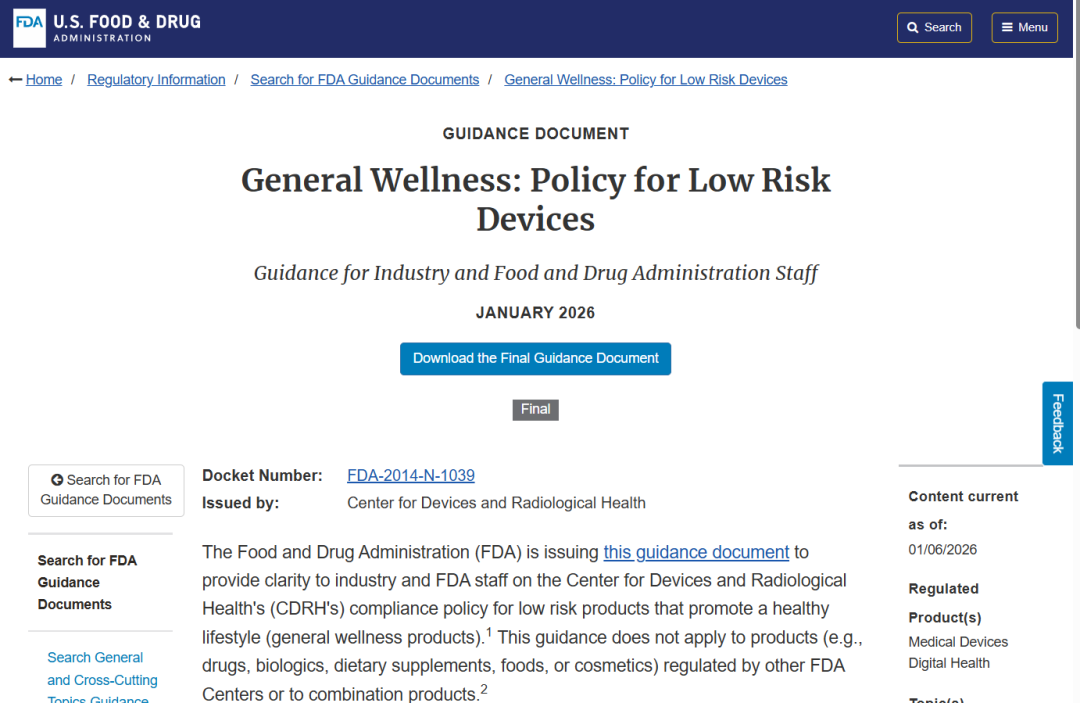
At the same time, the FDA formally updated and issued the guidance document General Wellness: Policy for Low Risk Devices (January 6, 2026 edition), making clear that low-risk general wellness products (such as fitness trackers, activity-monitoring apps, heart rate monitors, etc.), as long as theyare intended solely to promote a healthy lifestyle、do not involve the diagnosis, treatment, or prevention of diseaseand pose low risk, fall outside the scope of FDA medical device oversight, or, even if they technically qualify as medical devices, FDA does not intend to enforce premarket review or postmarket requirements.
Commissioner Makary said plainly in a Fox Business interview: "We want to provide clear guidance to tell companies that if a device or software merely provides information, such as step count, heart rate estimates, or sleep stages, it can remain outside FDA oversight. The one bottom line is this—do not claim 'medical-grade' accuracy, such as clinical-grade blood pressure measurement. We do not want users adjusting medication based on screening tools or estimated physiological parameters."
This policy strengthens and clarifies the existing framework in response to rapid technological development, aiming to help the FDA move at "Silicon Valley speed," promote innovation, attract investment, and still maintain the bottom line of patient safety. In the past, functions such as WHOOP blood oxygen/blood pressure features received warning letters for crossing the line. The boundary is now clearer: non-medical-grade claims → accuracy is left to the market; medical-grade claims → continued strict regulation.