I. Regulations/Purpose and positioning of the standard
• Implementing Regulation (EU) 2025/2086(JCAImplementing Regulation)
Purpose:Under theHTA parent Regulation (EU) 2021/2282 , establish an EU-level joint clinical assessment for medical devices andIVD (JCA)JCA-joint clinical assessments)processes, roles, timelines, and templates to scientifically compare relative effectiveness and safety and reduce duplicate assessments by Member States, and provide a harmonized clinical comparative evidence basis for Member States’ market accessdecisions.
Key points:Periodic decisions on the selection of product categories for inclusion; manufacturers7/60/100/165/30days and other hard deadlines;Annex I–V templates; the boundaries between confidentiality and disclosure; restart/update mechanism.
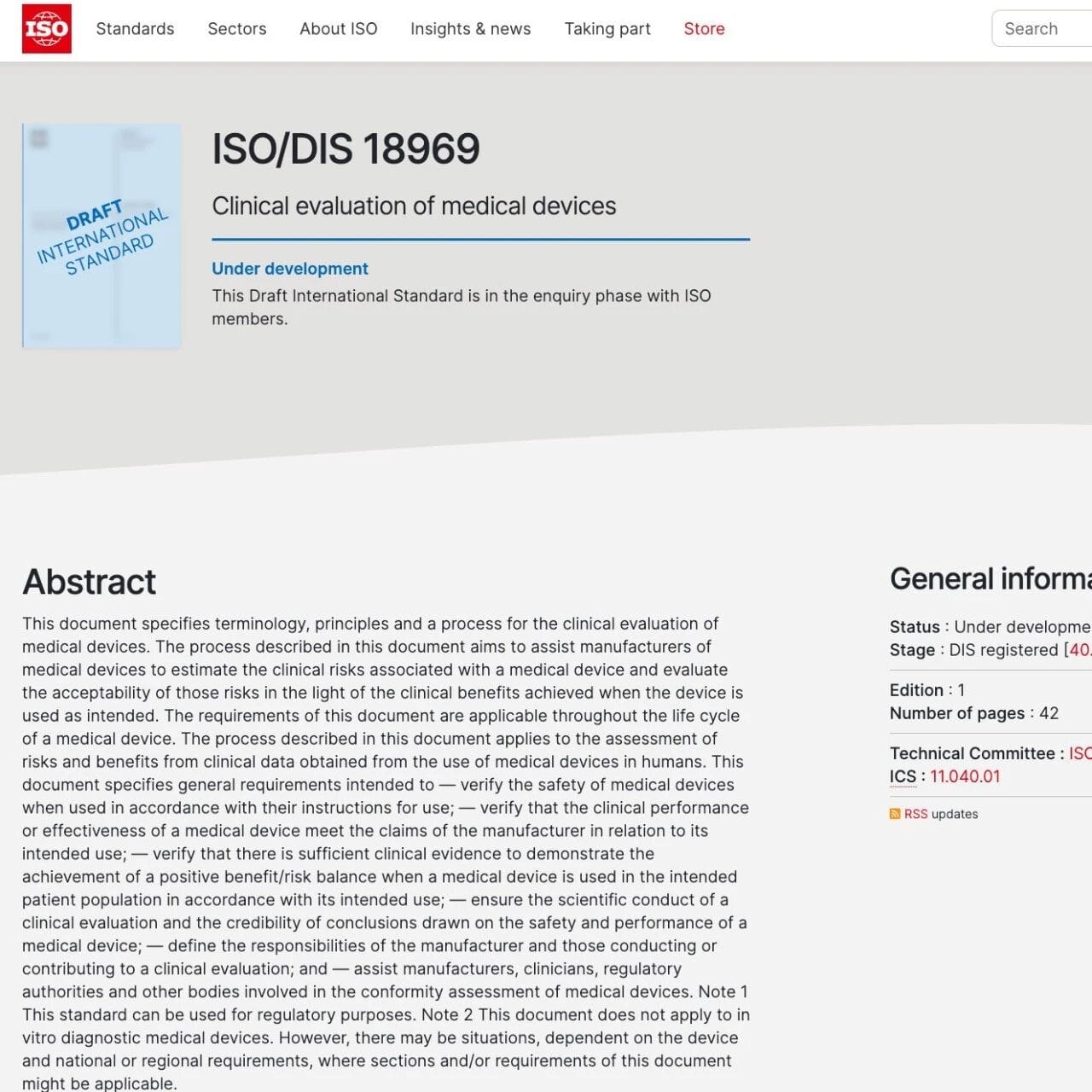
• ISO 18969(Clinical evaluation of medical devices)
Purpose:Providean internationally recognized process framework and methodological requirementsfor the clinical evaluation of medical devices throughout the product’sfull lifecycle(planning,→evidence collection,→evaluation,→reporting,→maintenance and updates), emphasizingrisk-clinical integrated judgment of benefit-risk andalignment with other standards (such asISO 14971、ISO 14155、ISO/TR 20416process alignment among these and similar standards).
Significance:Asan internationally recognized consensus standard, it provides manufacturers with“how to do it”methods and documentation requirements, facilitating alignment with regulatory requirements across multiple jurisdictions.
• MDRandMDCG guidance
MDR:the EU MDR, the foundational law for medical devices in the EU, which sets out clinical evaluation (Annex XIV), clinical evidence, andPMCFother mandatory requirements.
MDCG:WithinMDRthis framework, it provides operational guidance, such as:
MDCG 2020-6: determining whether legacy devices meet theMDRunder“sufficient clinical evidence”requirement;
MDCG 2020-13:CEARtemplates (NBassessment records for a company's clinical evaluation);
MDCG 2020-1: clinical/performance evaluation guidance for medical device software.
II.The relationship and key differences among the three
• MDR is mandatory“foundational regulation”;
• MDCG the guidance provides“underMDRhow to do it”forspecific explanations and templates;
• ISO 18969 providesinternationally accepted“methodologies and processes”standards, which can serve as a foundation for establishing an enterpriseQMS/clinical evaluation systembest practice;
• (EU) 2025/2086 takes the perspective of“market access/HTA”and, from that perspective,“how to organize cross-country joint comparative assessments (JCA)”providing processes and templates, and translating a company's clinical evidence into comparative conclusions that can be jointly adopted by Member States.
In short:MDR/MDCG ensures“can reach the market”;ISO 18969 ensures“Make clinical evaluation systematic and traceable”;2025/2086 Ensure“it can be assessed in a unified, standardized, and transparent manner for coordinated market access”。
3. Evidence loop and document linkage
The clinical evidence lifecycle (planning→generation→aggregation→assessment→maintenance) should be built systematically and reused across multiple areas:
• study/data layer: clinical trials (ISO 14155)、RWE/registration (ISO/TR 20416), risk management (ISO 14971)→ build a database;
• evaluation/report layer: conduct clinical evaluation according to ISO 18969 and produceCER(orPER);
• review/compliance templates: use MDCG 2020-13 of theCEARTemplate supportNBreview; for legacy devices, use as a referenceMDCG 2020-6to assess adequacy;
• HTA/Access layer: turnbased onPICOrelative effectiveness/safety comparison evidence, reuse and output according to (EU) 2025/2086 theAnnex III/IV/V template for use inJCA。
IV. Corporate compliance strategy and early positioning
A. system setup
1) Establish“clinical evaluation managementSOP”: led byISO 18969, linked toISO 14971(risk),ISO 14155(clinical trial),ISO/TR 20416(PMS)mapping;
2) set up“JCAresponse team”: coordinate with(EU) 2025/2086timelines and templates; registration, clinical,HTAquality, statistics, and data engineering roles, and other compliance system setup;
3) Document engineering: transformCER/PERstatistical plans, search records,PMCFand standardize materials to ensure traceability and version control.
B. Evidence planning
1) with“futureJCAofPICO”as the core principle, assess whether the comparator/endpoints/and follow-up are adequate, and supplement with additional studies or registries when necessary;
2) PrebuildJCAdatabases: in accordance withAnnex I/II operations;
3) Confidential information management: establish standards for asserting trade secrets and alternative databases, and train the team on protection mechanisms.
C. Practical response
1) and member states/HTAecosystem engagement: use Joint Scientific Consultation (JSC) or early methodological exchanges to reducePICOmismatch risk;
2) Establish“milestone”a mechanism:7/60/100/165/30a countdown board and alerts, and assign backup owners;
3) RWE/Update strategy: for(EU) 2025/2086 the update of/preconfigure a restart mechanism with real-world data and follow-up milestones.
V. Typical Challenges and Strategies
• PICOMismatch → Early-stageJSC+Protocol strategy;
• Evidence“Sufficient for market access, but not for comparison” → Pre-specify comparative controls and patient-centered outcome measures in the clinical protocol (Safety&performance parameters &AC&Clinical Benefits& SOTA);
• Document fragmentation → Establish a unified“evidence-to-template”evidence repository (CER→CEAR→JCA Annex);
VI. References and Original Links
• (EU) 2025/2086(EUR-Lex OJ):https://eur-lex.europa.eu/eli/reg_impl/2025/2086/oj/eng
• European Commission JCA Topic page:https://health.ec.europa.eu/health-technology-assessment/implementation-regulation-health-technology-assessment/joint-clinical-assessments_en
• ISO 18969 (ISO official standard page): https://www.iso.org/standard/85514.html
• MDR (EU) 2017/745(EUR-Lex):https://eur-lex.europa.eu/eli/reg/2017/745/oj/eng
• MDCG 2020-6 (sufficient clinical evidence - legacy devices): https://health.ec.europa.eu/system/files/2020-09/md_mdcg_2020_6_guidance_sufficient_clinical_evidence_en_0.pdf
• MDCG 2020-13 (CEAR template): https://health.ec.europa.eu/document/download/d1f5f404-0ab8-4ab6-9165-28885c645e74_en
• MDCG 2020-1 (clinical/performance evaluation for software): https://health.ec.europa.eu/system/files/2020-09/md_mdcg_2020_1_guidance_clinic_eva_md_software_en_0.pdf