If you are the person in the company who truly “works in compliance””——and is responsible forPMS、PSUR、PMCF、CAPA, and communication with the Notified Body——then you will probably feel this way:
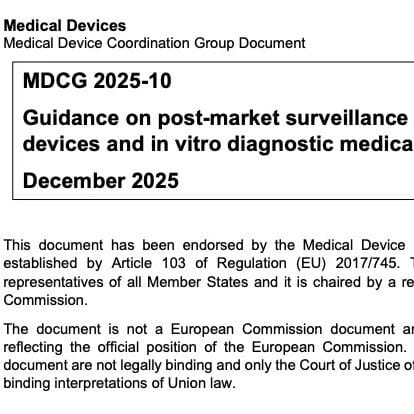
MDCG 2025-10 its release is not simply one more“guidance document”, but rather the EU regulatory authorities’PMSnew round of“recalibration”:
The question is no longer whether you“have done it”, but whether——
what you callPMSis genuinely managing product risk in practice?
In the article below, I will speak entirely from the perspective of an in-house compliance professional—not about concepts or by repeating the regulations, but about:
• what Notified Bodies are really looking at now(to be analyzed in detail in the next article)
• where companies are most likely to stumble
• how to movePMSfrom“document compliance”has become“system-level compliance”
1. The core change in regulatory logic:PMSis no longer“after-sales”, but rather“continuous product management”
In the past, many companies' understanding ofPMSwas:
complaints + adverse events + periodically issue aPSUR = PMSand call it done.
MDCG 2025-10 directly rejects this implicit logic.
It repeatedly emphasizes one term:systematic & proactive(systematic + and proactive).
Translated into business terms, this means:
• You cannot simply wait for problems to occur
• You must demonstrate that you have been continuously“looking for problems”
What regulators are now focused on is:
If your product truly has a trending risk, can yourPMSsystem detect it before the regulators do?
2. The point companies are most likely to underestimate:PMS Planit is now“Core document under review”
Many companies treatPMS Planit as:
Annex IIIa repetitive duplicate document: drafted once for registration and then left largely untouched.
But under theMDCG 2025-10framework,PMS Planit has essentially become:
a“design document for post-market product risk monitoring”。
During on-site or document review, the Notified Body will typically follow this line of questioning andPMS Planask:
• Why were these data sources selected?
• Why this frequency?
• Why this threshold?
• If the threshold is exceeded, who makes the determination? Within what timeframe must action be taken? (These are real deficiency letter questions that Clinsota has encountered when supporting clients with deficiency letter response solutions.)
If yourPMS Plancannot answer these questions,
even ifPSURit is written beautifully, it can still easily be deemed“the system is ineffective”。
III. From“passively receiving complaints”to“proactively seeking evidence”: this is the biggest gap companies need to close
MDCG 2025-10It clearly states:
Relying only on complaints and adverse events is not sufficient.
From a practical implementation perspective, Notified Bodies now generally expect to see:
• at least one proactive data source
• aligned with the device's risk classification
For example:
• IIb / IIIClass devices:
- literature monitoring
- user feedback surveys
- registry databases
- PMCFstudies
The key is not“how much you do”, but whether:
have you thought about this:
if an issue arises in the real world, what will I rely on to detect it?
4. A key change: thresholds (threshold) are becoming a hard review checkpoint
For many companies, the biggest problem inPMSis:
the data are there, but“what counts as a problem”is unclear.
MDCG 2025-10It is very clear:
PMSmust support continuous benefit--risk evaluation.
This means——you must have thresholds.
Practical recommendation (very important):
• you do not need a highly complex calculation
• But it must be logical, evidence-based, and documented.
For example:
• Incidence rate vs Pre-market expectations
• Whether the trend continues to rise
• Whether it is concentrated in specific batches/Population/Region
What Notified Bodies care more about is:
“Whether you have a clear decision-making pathway”,
rather than how sophisticated your statistical model is.
5.PMCFIt is no longer“"only if it can be avoided, it should be avoided"”, but rather“why it is not done must be clearly explained”
MDCG 2025-10hasPMCFexplicitly incorporated into thePMSsystem.
The logic is straightforward:
If you say it is not necessaryPMCF, you need to demonstrate——
that sufficient post-market evidence is already in place to continuously support safety and performance (the same old point).
The reality in practice is:
• High-risk
• New technology
• New indications
• Innovative use cases
These products,PMCFare becoming increasingly difficult to fully avoid.
A more practical strategy is:
to plan ahead“for the minimum acceptablePMCF”,
rather than waiting to patch things up when the Notified Body raises questions.
VI.PMSThe real“compliance point”: a closed loop, not a report
MDCG 2025-10One thing repeatedly emphasized is:
PMSthe output must genuinely affect the product.
In reviews, common follow-up questions include:
• Have thesePMSconclusions updated risk management?
• Was the Clinical Evaluation updated in parallel?
• Did it triggerCAPA?
• IFU/label changes?
• Did management review these conclusions?
In other words:
IfPMSthe data only stays inPSURthere,
then, in the regulator's eyes, it is“ineffective”。
7. How can companies put this into practice? A realistic, workable implementation path
From the company’s perspective, the most feasible approach is not to“start over from scratch”, but to proceed in three steps:
Step 1: conduct a genuinePMSgap assessment
not against the regulation, but againstMDCG 2025-10。
Ask clearly:
• our currentPMS, can it identify problems in advance?
Step 2: complete the three“critical interfaces”
• PMS → risk management
• PMS → clinical evaluation / PMCF
• PMS → CAPA / Changes
Step 3: TurnPMSinto something management can understand
• clear metrics
• clear trends
• clear decision records
8. Conclusion: Why this marks the beginning of “real compliance”
MDCG 2025-10It does not introduce entirely new obligations,
but it makes regulatory“expectations”clearer than ever before.
For companies, the real risk is not“The documentation has not been updated”,
rather,——
yourPMS, are you truly managing the product?
Companies that can answer this question
will be in an increasingly strong position in future reviews.