Clinsota
← Back to English Insights

Medical device regulatory insight · 2025-12-29

Administrative Provisions on the Management of Export Sales Certificates for Medical Devices issued, effective May 1, 2026

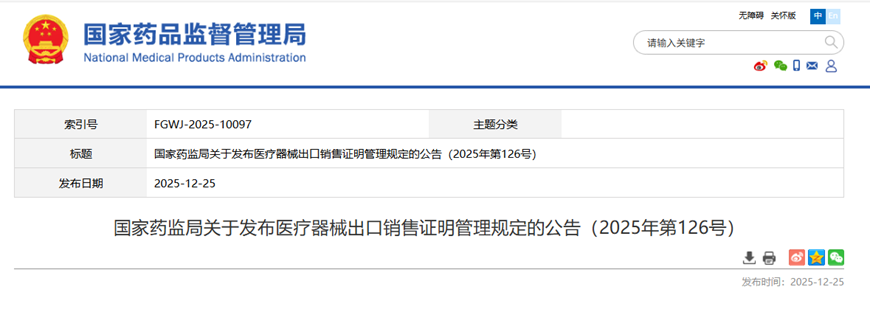
On December 25, the NMPA issued an announcement revising and releasing a new version of the Administrative Provisions on the Management of Export Sales Certificates for Medical Devices, effective May 1, 2026;

Administrative Provisions on the Management of Export Sales Certificates for Medical Devices issued, effective May 1, 2026
On December 25, the NMPA issued an announcement revising and releasing the new Administrative Provisions for Medical Device Export Sales Certificates, which will take effect on May 1, 2026; at the same time, Announcement No. 18 of 2015 of the former CFDA is repealed.

The new rules for Medical Device Export Sales Certificates split the application routes into Certificate (I)/(II) and also incorporateGMP conformity review into the regulatory framework, meaning that many companies that "export only and have no domestic registration" willfor the first time face stricter documentation requirements and possible on-site inspections. The full text of the regulation is available for download at the end of this article.

On the surface, this change appears to make the "service process more standardized," but its real impact on companies is:the export certificate is no longer just an administrative stamp, but rather adocumentation + QMScompliance screening


1 The most important change: the certificates are divided into (I)/(II), and the applicants have changed as well

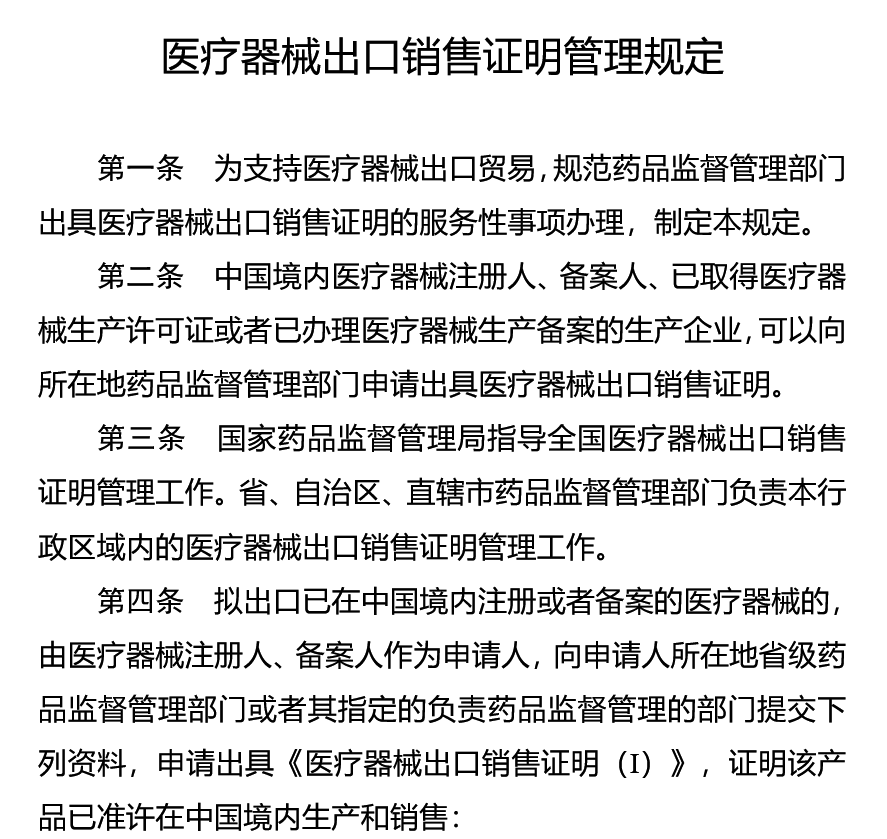
Certificate (I): If the product has already been registered/filed in China, the registrant or filing entity applies, certifying that it "has been approved for manufacture and sale within China." (Article 4) 


Certificate (II): If the product has not been registered/filed in China, the actual manufacturer applies, certifying that it "is regulated as a medical device in China but has not been registered/filed and is intended only for sale outside China," and expressly requiring the enterprise to have manufacturing conditions that comply with medical device GMP requirements. (Article 5) 


Clinsota's interpretation is as follows:

In the past, many companies treated the "export certificate" as just another item in an export documentation package; by splitting it into two pathways, the new rules are essentially telling the market—before you can claim export compliance support, you must first clearly establish who you are, whether you can manufacture, and whether your QMS is adequate.


2 The review logic is now stricter: it not only reviews the documentation, but also examines "GMP conformity," and on-site inspections may be conducted where necessary

The issuing authority must review the authenticity, legality, and validity of the submitted materials,as well as the manufacturer's GMP conformityand may conduct on-site inspections where necessary. (Article 9) 


And it explicitly spells out three typical cases in which a certificate will not be issued:

    • Listed on the Serious Illegal and Dishonest Entities List

    • Providing false materials

    • Under suspension of production and rectification / pending case handling (Article 9, paragraph 2) 


Clinsota Insight:

“Export certificates will increasingly look like 'regulatory endorsement documents': if the materials are not genuine, the system is unstable, or the compliance status is not in order, you should not expect to obtain the certificate smoothly.”


3 The point most likely to trigger a return: the “production scope subcategory + IVD methodology” in Certificate (II)
There are two requirements in the Certificate (II) materials that are easy to overlook but most likely to cause a bottleneck:
The production scope must cover an explanation of “the subcategory and primary product category to which this product belongs” (Article 5(3))
If it is an in vitro diagnostic reagent,it must also explain that the proposed export product uses the same methodology as the product being manufactured(same as above) 
Practical tip:
Many companies lose out on the “textual consistency of the production scope” — the issue is not whether you can make the product, but whether the content stated on your license/filing matches. Problems like this are usually not solved through registration; they require quality/production compliance plus license management.


4 A clause that is easy to overlook but can be fatal: honesty, integrity, and end-to-end traceability
Article 8 states the responsibility very plainly:
The applicant must ensure the materials are true, lawful, accurate, complete, and traceable; it must also establish and retain records of the export certificate, packaging, instructions and label samples, customs declaration forms, quantity, output value, and importing country/region, so that the export process is traceable. 
Further down, Article 11 is even more forceful:If a certificate is fraudulently obtained, forged, or altered, it will be invalidated and recorded in the credit file,and no further certificates will be issued within 5 years; if a crime is suspected, the case will be referred。 
This is not a reminder; it is a hard red line.

5 Efficiency-related changes: maximum 20 working days, electronic certificates have equal effect, and the validity-period logic is clearer
Provincial authorities may issue detailed rules, with the processing time capped at no more than 20 working days; on-site inspection and rectification time are excluded; online applications are encouraged. (Article 12) 
Electronic certificate has the same legal effect as the paper certificate (Article 13) 
The validity period must not exceed the earliest expiry date among the various certificates in the submission dossier; for Class I devices, the certificate validity period must not exceed 3 years; if a license or certificate is suspended, revoked, canceled, or terminated, the certificate becomes invalid as of the corresponding date. (Article 7)
Reply with “Export Sales Certificate” to download the full text of the regulation directly.