


CE MDR 临床评价计划核心要点和模版
法规背景
Info.
An effective Clinical Evaluation Plan acts like a guideline, guiding and harmonising the clinical evaluation process and ensuring sufficient rigor and objectivity from start to finish.
一份高质量的临床评价计划就如同一个导航,它能指导并协调临床评价过程,确保从始至终都具备足够的严谨性和客观性。
Article 61(3) of the MDR states that a clinical evaluation must “follow a defined and methodologically sound procedure”, meaning that a Clinical Evaluation Plan needs to be established in advance and should define how the evaluation shall be conducted.
《医疗器械法规》第 61 条第 3 款规定,临床评价必须 “遵循既定且方法科学合理的程序”,这意味着需要预先制定临床评价计划,并明确评价的实施方式。
MDR Annex XIV Part A provides further details on requirements for CEPs, stating that it should include at least the following:
《医疗器械法规》(MDR)附件 XIV A 部分提供了关于临床评价报告(CEPs)要求的更多细节,其中规定临床评价报告至少应包含以下内容:
・An identification of the GSPRs that require support from relevant clinical data;
・A specification of the intended purpose of the device;
・A clear specification of intended target groups with clear indications and contra-indications;
・A detailed description of intended clinical benefits with relevant and specified clinical outcome parameters;
・A specification of methods to be used for examination of qualitative and quantitative aspects of clinical safety with clear reference to the determination of residual risks and side-effects;
・An indicative list and specification of parameters to be used to determine, based on the state of the art in medicine, the acceptability of the benefit-risk ratio for the various indications and for the intended purpose or purposes of the device;
・An indication how benefit-risk issues… are to be addressed; and
・A clinical development plan
・对需要相关临床数据支持的通用安全与性能要求(GSPRs)的识别;
・对器械预期用途的说明;
・对目标人群的明确界定,包括明确的适应症和禁忌症;
・对预期临床获益的详细描述,以及相关且特定的临床结局参数;
・对用于检查临床安全性定性和定量方面的方法的说明,并明确提及对残余风险和副作用的判定;
・基于医学当前技术水平和最佳实践经验,用于确定该器械各种适应症以及一种或多种预期用途的获益 - 风险比可接受性的参数的指示性清单和说明;
・对如何解决获益 - 风险问题的说明;以及
・临床开发计划
实践经验
Prac.
However, this list constitutes the bare minimum of what should be included in a CEP and, as written in the MDR, isn’t easy to follow. Let’s look in more detail at how to structure a Clinical Evaluation Plan.
然而,这份清单仅包含了临床评价计划(CEP)应涵盖的最基本内容,而且正如《医疗器械法规》(MDR)中所写的那样,其表述并不容易理解和实践。下面我们来更详细地了解如何构建高质量且符合审核员口味的临床评价计划。
How should a Clinical Evaluation Plan be structured?
临床评价计划应如何构建?
When planning the structure of a CEP, it’s worth having a simple framework in mind that can be used as a reference point. One such framework of key requirements is as follows:
在规划 CEP 的结构时,记住一个可作为参考点的简单框架是很有价值的。其中一个关键需求框架如下:
・Identification, classification and general description of the device
・Background and purpose of the CEP
・Summary of CEP methodology (e.g. use of literature / equivalence route, etc)
・A hypothesis to be tested during the evaluation
・Intended purpose, clinical benefits, indications and contraindications
・Identification of similar devices
・Analysis of relevant and non-relevant GSPRs with justification for any non-relevant
・A detailed search protocol for identifying, appraising and analysing clinical evidence.
Each section should be clearly written in sufficient detail to enable people other than the author to precisely follow the ‘recipe’.
Two aspects of a Clinical Evaluation Plan that commonly cause confusion are the need to construct a hypothesis and the requirement to set out a Search Protocol. For this reason, each of these deserves specific consideration.
每个部分都应撰写清晰且内容详尽,以便作者以外的人能够准确遵循这个 “方案”。临床评价计划中通常会引起困惑的两个方面是构建假设的必要性和制定检索方案的要求。因此,这两个方面都值得进行专门的考量。
CEP 模版
Template.
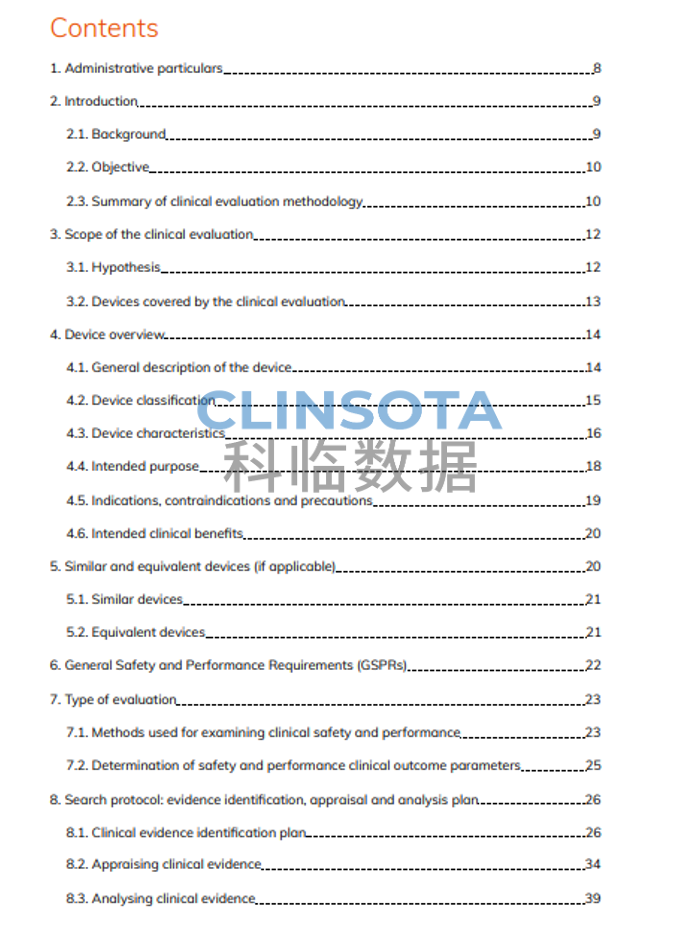
以下根据MDR及MDCG 要求编写的部分临床评价模版大纲,仅供参考:
核心考量
Propose.
1. 在CEP阶段就要计划好所需要的可支撑宣称的安全性和有效性的临床数据(包括但不限于临床试验数据);
2. 在CEP阶段就应该确定好等同器械和相似器械,如果要走等同路径;
3. 确定好想要宣称的Clinical Benefits 且要计划好可以证明它的证据范围;
4. 确定好SOTA与Safety&Performance 及AC;
5. 制定“高效、科学、符合逻辑且可追溯“的文献检索范围和策略
6. 根据“计划好的”临床评估“框架”对应执行收集临床证据。